Monday, March 19, 2012

Book Review: Running Lean: Iterate from Plan A to a Plan That Works

Book Review: Running Lean: Iterate from Plan A to a Plan That Works by Ash Maurya: Publisher- O’Reilly: ISBN- 13: 978-1449305178

Running Lean is one of the essential books for Lean stratups. Books take you to journey of Lean Startup and focuses on Customer focused approach. Ash takes gives you very prescriptive dose of running a startup while minimizing Risk and maximizing the flexibility.

Ash draws heavily from Eric Ries book (The Lean Startup: How Today's Entrepreneurs Use Continuous Innovation to Create Radically Successful Businesses).

The book's chapters are:

1. Introduction
2. Meta-Principles
3. Running Lean Illustrated
4. Create Your Lean Canvas
5. Prioritize Where to Start
6. Get Ready to Experiment
7. Get Ready to Interview Customers
8. The Problem Interview
9. The Solution Interview
10. Get to Release 1.0
11. Get Ready to Measure
12. The MVP Interview
13. Validate Customer Life Cycle
14. Don't Be a Feature Pusher
15. Measure Product/Market Fit
16. Conclusion
Appendix - Bonus Material - comments and insights on topics including: building a slow burn startup, thoughts on premature funding, achieving flow, pricing models, teaser and landing pages, sales letters, continuous deployment, conversion dashboards

The book is essential for any Start up, not only Tech Start ups.

Disclaimer: I did not get paid to review this book, and I do not stand to gain anything if you buy the book. I have no relationship with the publisher or the author.

Further Reading: There are score of books on Lean Business Practices and especially few in startup arena. Running Lean has drawn heavily from :

1. The Lean Startup: How Today's Entrepreneurs Use Continuous Innovation to Create Radically Successful Businesses by Eric Ries
2. Business Model Generation: A Handbook for Visionaries, Game Changers, and Challengers
3. Business Model You: A One-Page Method For Reinventing Your Career

One can get more information about book and related topics from:

1. Book’s web site: http://www.runningleanhq.com/
2. Ash’s website: http://www.ashmaurya.com/
3. Lean Canvas: http://leancanvas.com/
4. User Cycle: http://usercycle.com/
5. Review: http://kevindewalt.com/blog/2011/02/26/running-lean-book-review-my-hacks

Thursday, March 15, 2012

Daily Stand up

During daily stand up meeting (of course project is using Scrum) how status is collected or stated in your teams.

1. Each pig gives his/her status and Scrum Master takes notes of that
2. Scrum Master iterate over each story and pigs involved in that story speak about their story

Under what conditions one will select one of the methods?

Thursday, February 9, 2012

Inverted Funnel Model

Inverted Funnel Model

Saturday, January 21, 2012

Burn Chart

In Scrum, Burn chart is used extensively by each stake holder. But if someone looks at the assumptions which are used to draw Burn Chart, utility of it diminishes.

One of the assumptions while drawing Burn Chart is that each Pig is loaded 100%. In real life is this true? I do not think so.

What do you say?

Tuesday, January 17, 2012

Book Review: Inside Cyber Warfare

Book Review: Inside Cyber Warfare by Jeffrey Carr: Publisher- O’Reilly: ISBN- 13: 978-0596802158

This is second edition of book. I read book’s first edition and found fascinating. My motivation of reading the book is from software architect perspective. I found the book interesting though information provided in the book is readily available on internet but not at one place.

Jeffrey Carr maps cybercrime, cyber espionage and cyber aggression from state and non-state actors and how they are inter-related.

Book nicely explains complexities of cyber-attack and its implications.

Disclaimer: I did not get paid to review this book, and I do not stand to gain anything if you buy the book. I have no relationship with the author. I got this book under Orielly’s book review program.

Further reading: A competing book is Cyber War: The Next Threat to National Security and What to Do About It  and Cyber Warfare: Techniques, Tactics and Tools for Security Practitioners

One can get more information about book and related topics from:
1. Book at Amazon: http://www.amazon.com/Inside-Cyber-Warfare-Mapping-Underworld/dp/1449310044
2. Publisher: http://shop.oreilly.com/product/0636920021490.do

Wednesday, January 11, 2012

Book Review: APIs: A Strategy Guide

Book Review: APIs: A Strategy Guide by Daniel Jacobson, Greg Brail, and Dan Woods: Publisher- O’Reilly: ISBN- 13: 978-1449308926

This is one of the first books on strategic part of API in software industry. APIs: A Strategy Guide is not for developers or designers but for non-technical folks of Software industry – PMs, Business Development staff, C Level Executives and anyone who is interested in Software marketing and Sales and its management.

Book is written in very lucid manner though in initial chapters same information and facts are repeated but still overall book maintains good flow.

Mix of Authors makes good combination. Provider of API related products and Services - Greg Brail, CTO Apigee , customer - Daniel Jacobson, Director of Engineering Netflix API and Researcher, Speaker, & Entrepreneur - Dan Woods.

Book is consisting of eleven chapters and each chapter takes a dive into API strategy and business. Neither a deep dive nor a shallow one.

Book is certainly a good read and going to be on my book shelf for long time.

Disclaimer: I did not get paid to review this book, and I do not stand to gain anything if you buy the book. I got this book as reviewer from publisher. I do not have any relationship with the author.

Further reading: A complementary book is REST API Design Rulebook by Mark Masse and RESTful Web Services Cookbook: Solutions for Improving Scalability and Simplicity by Subbu Allamaraju.

One can get more information about book and related topics from:

1. Book at Aamazon: http://www.amazon.com/APIs-Strategy-Guide-Daniel-Jacobson/dp/1449308929
2. Apigee: http://apigee.com/
3. Publisher: Orielly: http://shop.oreilly.com/product/0636920021223.do

Thursday, December 22, 2011

Feedback and business software

If we look at business software (custom made or off the shelf), most of them rely of feedback mechanism but feedback mechanism is built into the process which is largely human driven not on the automatic path. This thought makes any process human intensive and resource hungry.
Any process can be represented as

In this system it has been assumed that system is perfect, input received by system are perfect and comply to specifications ( zero tolerance), System is perfect (Zero tolerance) and always work as though of ( not only as designed). But we do not live in utopia.
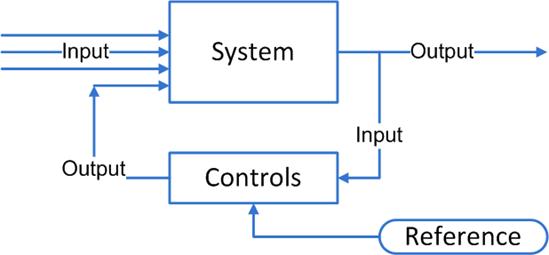
To accommodate imperfect world, feedback based systems are used.


Feedback systems are basis of control engineering.
Control engineering basic foundation can be summarized as:
1. A system that has no corrective feedback is likely to diverge from the desired output.
2. A system that tries to correct too quickly will likely overrun the mark and oscillate around the desired value.
3. A system that corrects too slowly will take a long time to reach the desired value, if it ever does.
4. A system with delayed corrective feedback will generally oscillate at a frequency related to the delay time.

From system thinking perspective, where cause and effect loop into feedback system, one can think of:

1. Stabilizing Loop: It leads to a balance. The more food I eat, and then the fuller I feel. The fuller I feel then the less food I eat.


2. Reinforcing Loop. This loop continues till some external agent intervenes. The more I think of food then the hungrier I get and the hungrier I get then the more I think of food.


3. Choice: This is not about loop but making a choice. Our machines are not intelligent (sic!) enough to make choice, so human (or living being) are invariably get involved in these type of system. I think about food and make a choice to eat food. Choice may lead to increase or decrease in effect.


4. Choice and Reinforcing Feedback: In some cases choice and reinforcing feedback combine and create an addictive effect. I think about money, I earn more money. I think more about money.

The clouds represent observable (and potentially measurable) quantities. A plain arrow indicates that an increase or decrease of one quantity influences a similar increase or decrease of the other.
If there is a dot on the arrow, then the effect is the opposite—an increase of one influences a decrease of the other.

With all of SOA and BPM why we are not able to deploy Stabilizing and Reinforcing Loop  mechanisms in business software?


References:
1. http://www.developerdotstar.com/mag/articles/gray_diagram_of_effects.html
2. Quality Software Management, Vol 1: Systems Thinking by Gerald M. Weinberg
3. The Fifth Discipline: The Art & Practice of The Learning Organization by Peter M. Senge