Thursday, October 24, 2019

Semantic Journey of Agile


In the year 2006 Martin Fowler invented a new word “Semantic Diffusion”.  He described the new word as: 
Semantic diffusion occurs when you have a word that is coined a person or group, often with a pretty good definition, but then gets spread through the wider community in a way that weakens that definition. This weakening risks losing the definition entirely - and with it any usefulness to the term.
 In one of his articles, he argued that the term “Agile” is a victim of Semantic Diffusion  (https://martinfowler.com/bliki/SemanticDiffusion.html).
Let’s try to understand at what stage of semantic life, is the term  Agile now.
In 2001, a new word was coined– “Agile”.  It was confined to the values and principles espoused in the Agile manifesto of software development.


By the year 2006, the term “Agile” was reaching far beyond the traditional software development space, with the human aspect of the software getting more weightage. Also, Agile started to get traction in the maintenance work. 


This picture clearly depicts the signs of Semantic Diffusion.
In the year 2019, Agile has become popular in Marketing & Sales, Budgeting, Human Resource Management, touching almost every aspect of organizational life. 
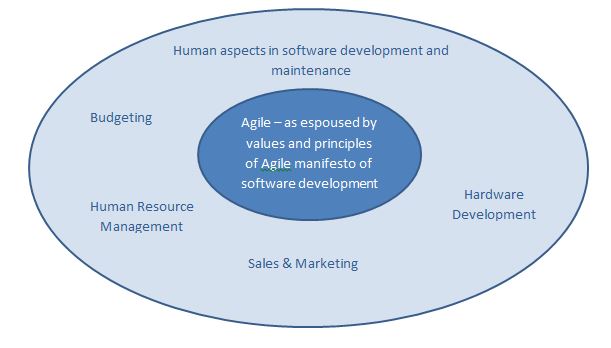

I am sure this image clearly points toward overloading.
What next? Does the term “Agile” has Rock Star syndrome – live fast, die young? Or, something else is happening. 
In my view Agile is moving toward the “Semantic Expansion”; you can blame me for neologism.  Semantic expansion occurs when overloading leads to fragmentation of word via various suffixes and prefixes to define similar situations as espoused in the original meaning of the word, in various contexts.
For example Agile HR, Agile Marketing, Agile Project Manager, Agile Organization, Agile Project Manager, Agile Budgeting, Agile Team, etc.


On similar lines, DevOps lineage can be traced with DevSecOps, NoOps, DevOps Engineer, etc.

Tuesday, September 10, 2019

Pictures to represent DevOps


Open your browser and search for DevOps. Your search result is full of a picture (or its variations) which essentially lists SDLC steps in an eight shape.


Certainly it is a great picture, but does is depicts DevOps in its full glory? I think it is not. We need imagery which can depict business as well as technical aspects of DevOps. I am using two pictures to depict DevOps in its full glory, one each for Business and Technical audiences in mind.

Let’s talk about Business audiences first. These audiences have no appetite to divulge into technical details though love to keep themselves updated about technology and its effects on the business.


This picture focuses on customer experience and Market Demand and mechanism to close this loop via Market feedback and continuous Delivery.  To complete this loop, organization focuses in Continuous Planning, Continuous Integration, Continuous Deployment & Release, and Continuous Operations. To reduce the rework due to security related requirements, security should be embedded into each and every step of Software Development & Operation. To reduce the cognitive load on the Development team, security by design paradigm can be employed. To reduce cost of development & operation and risk Shift Left paradigm need to be embraced.

Let’s talk about technical audiences. These audiences are keen to take deep dive into technical realm. Here the focus is on practices at Application as well as infrastructure level, Work Item tracking, Integrated Dashboard, Collaboration among stakeholders, Knowledge repository, Security, and incident management. In the picture of DevOps for Technical folks, mapping to Business picture is provided by incorporating Capabilities over Practices and CICD pipeline.


In business audience focused picture, there are several feedback loops are depicted to emphasize the continuous feedback mechanism. In Technical audience focused picture only one feedback loop is depicted to encompass numerous small ones which results from practices listed below the Pipe. Delivery is achieved with various small steps, not necessarily in sequential manner.